
For Educator Teams
Make PLC Time Worth the Time
Small Experiments. Real Evidence. Visible Improvement.
Adaptive PLC helps educator teams turn collaboration into visible improvement through a clear direction, small experiments in practice, and evidence that helps teams decide what to do next.
Audiences
Who This Is For
Adaptive PLC is for educator teams and school leaders who want collaboration time to become more focused, visible, and useful.
School Leaders
For leaders who want PLC time to produce visible instructional improvement without adding another compliance process.
Instructional Coaches
For coaches helping teams clarify goals, use evidence, and keep improvement work moving.
PLC Facilitators
For facilitators who need a simple structure for moving from discussion to action.
Educator Teams
For teams ready to focus on one meaningful improvement and learn from what happens in real classrooms.
The problem
When PLCs Drift
Even strong PLCs can drift when discussion becomes disconnected from action and evidence. Teams spend time talking about improvement without creating enough opportunities to learn from what happens in practice.
The meeting can be thoughtful. People can care deeply. Notes can be taken. But if the work is not visible enough, small enough, or connected closely enough to classroom evidence, the same issues return again and again.
Discussion Replaces Action
The team talks through the problem, but leaves without one clear change to try.
Evidence Gets Disconnected
Data is reviewed, but it does not clearly shape the next classroom move.
Follow-Through Fades
Good intentions get buried between meetings because the work is not visible enough to hold.
The rhythm
How Adaptive PLC Works
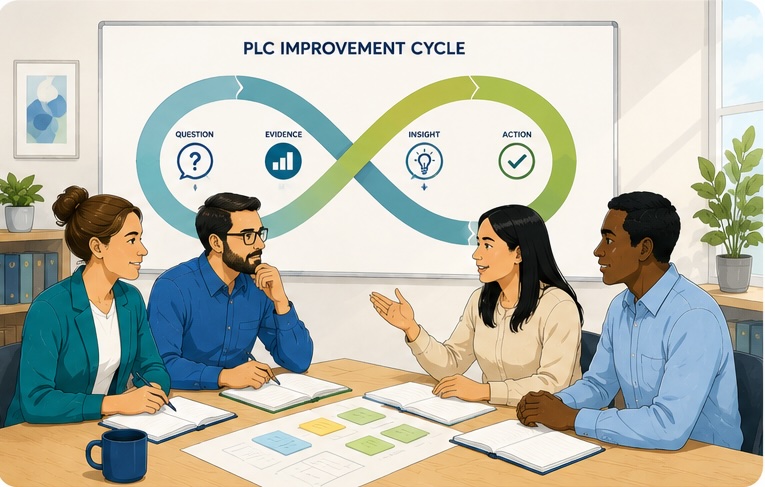
Teams set a direction, run small experiments, learn from evidence, and improve over time.
Direction
Start with a meaningful outcome, not a prescribed solution.
Experiments
Try small changes in real classrooms instead of spending weeks refining plans.
Evidence
Look at what students and educators actually experience to understand what's helping.
Improve
Build on what works, adapt what does not, and make steady progress over time.
In practice
What This Can Look Like
- Direction: A team notices that students are struggling to explain their thinking clearly. They agree this is the meaningful outcome to work on.
- Experiment: Instead of building a long plan, the team chooses one discussion routine to try in class next week.
- Evidence: They decide what to look for in student responses and classroom conversation. When they come back together, they share what they noticed.
- Improve: They use what they learned to decide whether to keep the routine, adjust it, or try something else. Each cycle teaches them more about what works for their students.
Next steps
Choose Your Path
New to Adaptive PLC?
See how the model works and how teams move from talk to classroom change.
See the modelReady to try it?
Download the free guide and see the improvement cycle, team roles, routines, and visible artifacts.
Get the Free GuideWant to implement it?
Join the waitlist for Adaptive PLC Essentials, an on-demand course designed to help teams apply the model with confidence and build a sustainable rhythm of improvement.
Join the Essentials waitlistNeed help applying it?
Use the Adaptive PLC Assistant to clarify a goal, choose a small experiment, or prepare for a review.
Try the AssistantCompanion project
Connected to Agile Classrooms
Adaptive PLC is a companion project from Agile Classrooms and Authentic Learning Alliance, built for educator teams rather than student-facing classroom routines.
Agile Classrooms focuses on the systems students use to make learning visible, collaborate, and improve. Adaptive PLC focuses on the systems adults use to improve teaching and learning together.
They are connected by the same belief: meaningful improvement happens through visible work, short learning cycles, shared ownership, and reflection grounded in real evidence.
Explore the Agile Classrooms framework for the student-facing side of the ecosystem.
Help Your Team Move From Talk to Learning
If your PLC time feels stuck between discussion and classroom change, Adaptive PLC offers a practical way to learn what works through small steps, evidence, and adaptation.