Project-Based Learning (PBL) was supposed to be the answer. It promised real-world engagement and 21st-century skills like collaboration, critical thinking, and creativity.
I believed in it. I led district-wide PBL initiatives.
But what I saw in classrooms didn’t match the promise.
We weren’t preparing students for the future.
We were giving them a 20th-century operating system disguised as innovation.
Emerging research confirms what many educators have felt: PBL has structural flaws that limit its effectiveness. And those flaws come with a cost.
Five Research-Backed Flaws of PBL
1. PBL Is Hard to Integrate Into Daily Learning
“It feels like I'm duct-taping creativity onto test prep.”
PBL is often treated as an add-on, crammed on top of core instruction.
Teachers are forced to juggle curriculum pacing guides with massive projects. It creates stress and fragmentation.
2. You Spend More Time Reporting Than Learning
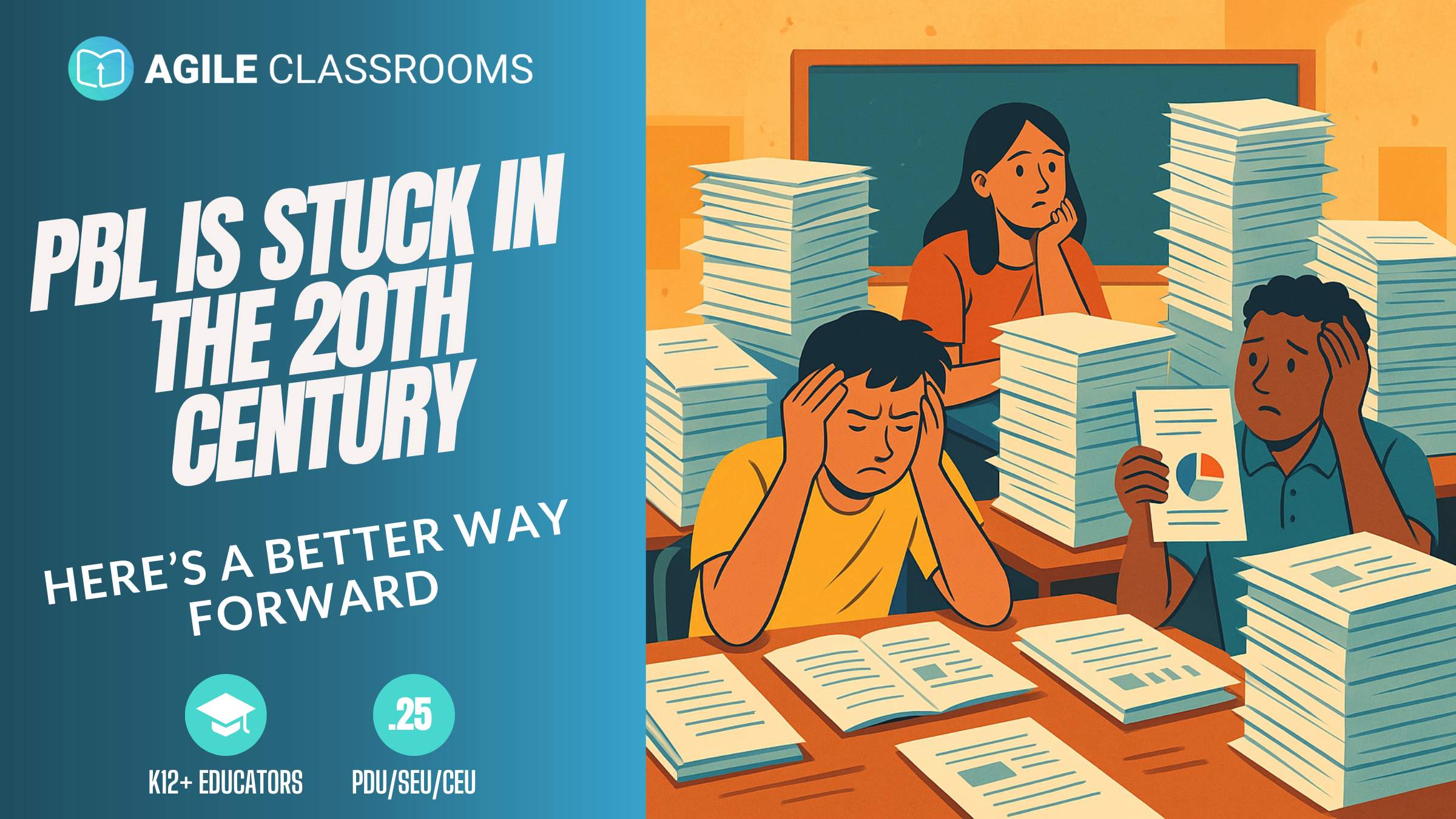
Teachers implementing PBL report massive time drains. Not on teaching, but on managing paperwork, schedules, and administrative overhead.
Research shows PBL demands constant attention to process: forms, rubrics, and documentation that often replace actual learning time.
3. Skills Don’t Stick With One-Off Practice
A core flaw of PBL is that it throws students into complex, collaborative projects without the foundational skills needed to succeed.
Studies describe PBL as:
“The most inefficient form of learning that still works.”
Why? Because skills like planning, teamwork, and iteration don’t develop through exposure. They develop through repetition.
4. It’s Based on Outdated Project Management
PBL follows a traditional “waterfall” model: big plans, big execution, big final product.
But modern workplaces have moved on.
Research confirms PBL mirrors a rigid, top-down system:
- Long upfront planning
- Documentation at every step
- Feedback only at the end
5. One-and-Done Planning Doesn’t Build Skill
In typical PBL, students plan once—usually at the start—and then execute.
But planning is a skill. And no skill improves with one attempt.
Educators note that for PBL to work, students must already have strong planning and conceptual understanding.
But often, they don’t. And they’re not given the chance to build it.
Even Daniel Pink Saw This Coming
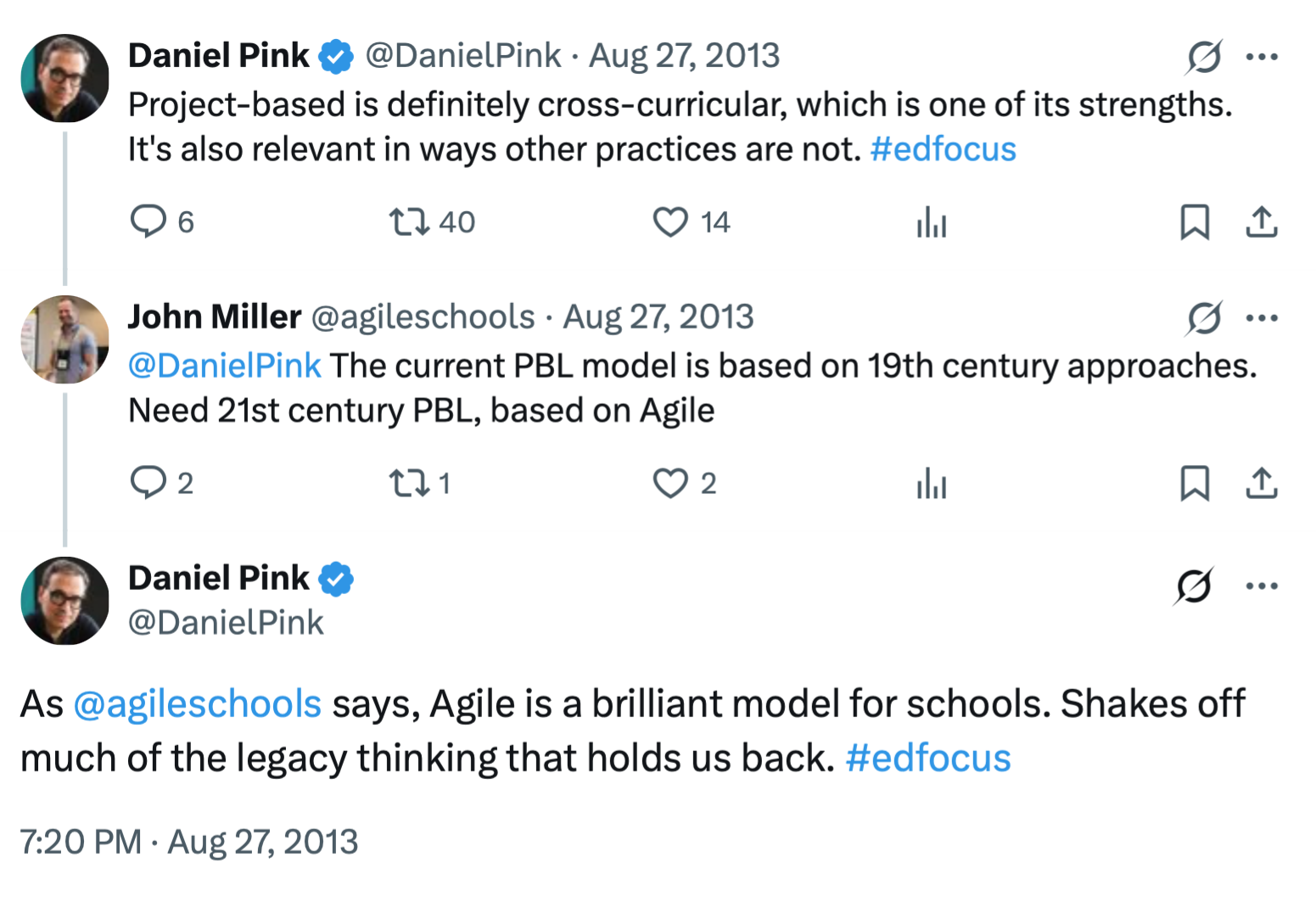
Back in 2013, I shared a thought on Twitter:
“The current PBL model is based on 19th-century approaches. We need 21st-century PBL, based on Agile.”
Daniel Pink, bestselling author of Drive and A Whole New Mind, replied:
“Agile is a brilliant model for schools. Shakes off much of the legacy thinking that holds us back.”
That was over a decade ago. And yet, most classrooms are still stuck in systems built for the industrial age, not the innovation economy.
The Damage Adds Up
When PBL doesn’t work as promised, it leaves a trail of unintended consequences:
- Teachers burn out trying to manage everything alone
- Students feel lost and unsupported
- Skills stay surface-level, not mastered
- Curriculum alignment collapses, making scaling hard
- And worst of all, we think we’re preparing students for the future, but we’re not
So What Do We Do Instead?
We stop tweaking the system. We change the operating system.
Agile Classrooms isn’t a new initiative.
It’s a different way of running the classroom.
A modern, flexible framework built on the same principles used by the world’s most innovative organizations.
Where PBL stumbles, Agile Classrooms delivers.
Why Agile Classrooms Works
- Integrated into the daily flow of learning
- Minimal admin overhead with visible routines and shared artifacts
- Frequent skill practice through weekly Learning Sprints
- Built on modern Agile methods, not outdated models
- Iterative planning so students improve every week, not just at the end
Agile Classrooms gives students the chance to practice what matters—collaboration, planning, focus, ownership—through real repetition and reflection.
You don’t need to do more.
You just need to work differently.