
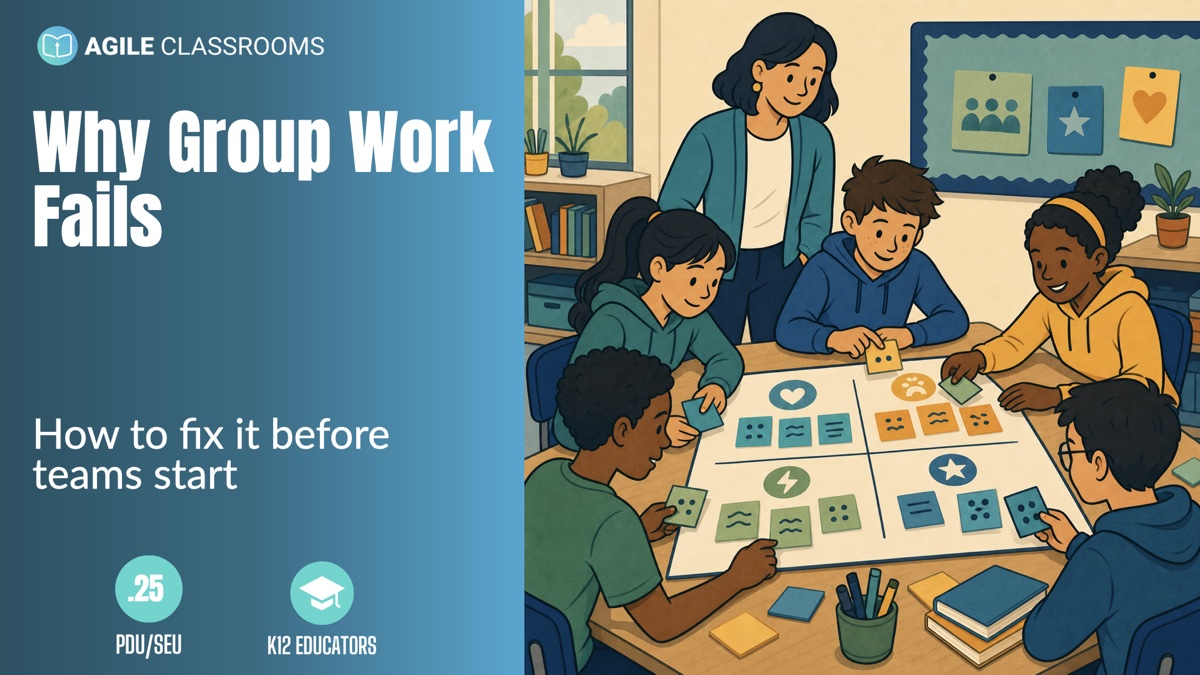
A teacher asks student teams to create norms.
The team writes the usual words: respect each other, communicate, stay on task. Nobody disagrees. The agreement looks reasonable. It may even look like student voice.
Then the group gets into real work.
One student dominates the conversation. Another student goes quiet. Someone misses a commitment. Two students disagree and the disagreement disappears underground. The teacher steps in again, not because the task is unclear, but because the team has no usable way to work through the problem.
A vague agreement is not a working agreement.
This is the first article in a short Team Alliance series for teachers who want student teams to work with clearer agreements, better choices, and less teacher rescue.
The series will help you:
- see why vague team norms break down during real group work
- help students choose stronger behaviors, conflict protocols, and accountability moves
- facilitate the Team Alliance process so the agreement becomes something teams actually use
Student Voice Needs Working Language
Student voice is not the problem. Involving students in the way their teams work is the right instinct.
The problem is asking novice collaborators to invent a collaboration system from scratch.
When students are asked, "What should our norms be?" they often reach for values everyone already knows are good. Respect. Responsibility. Communication. Kindness. Focus.
Those words matter. But they do not tell a team what to do when collaboration gets hard.
What does respect look like when someone interrupts?
What does responsibility mean when a task is late?
What does communication mean when two students disagree and both think they are right?
If the agreement cannot answer those questions, it will not help much when the group needs it.
Structure does not silence student voice. It makes student voice usable.
A value is a direction. An agreement is a decision.
That distinction matters.
Respect is a useful value. But it is not yet a usable team agreement. A more useful agreement sounds like: We wait for the current speaker to finish before sharing our own idea.
That sentence gives the team something to notice. It gives students language they can use before the teacher has to rescue the conversation. It turns a value into a behavior.
The same move works across the agreement.
Responsibility becomes: If I cannot finish my part, I tell the team before the work time ends.
Communication becomes: If we disagree, we each explain our reason before we vote or ask for help.
This is the practical test:
Could students use this agreement before asking the teacher to rescue the team?
If the answer is no, the agreement may be nice. It is not yet useful.
The Classroom Cost of Vague Agreements
Teachers do not need another article telling them group work is hard.
They already know.
They know the same few students can end up carrying the work. They know free riding can hide behind the word "team." They know a group can look productive from across the room while one student is quietly carrying the whole thing. They know a quiet student can disappear in a group that technically looks busy. They know conflict does not always look like conflict. Sometimes it looks like silence, avoidance, or one student taking over because that feels faster.
The cost is not only student frustration.
The cost is teacher rescue time.
When the team has no agreement for participation, the teacher has to manage participation. When the team has no agreement for conflict, the teacher becomes the conflict protocol. When the team has no accountability mechanism, the teacher has to reconstruct who did what, who tried, who avoided, and who got stuck.
That is why vague norms fail. They do not fail because students are careless. They fail because the agreement does not give students enough to work with.
Give Students Choices, Not Scripts
The answer is not to write the team agreement for students.
That just replaces vague student voice with teacher control.
The better move is to design the decision environment. Give students structured choices. Give them examples. Give them banks of possible values, behaviors, conflict protocols, and accountability mechanisms. Then let them choose what fits the team and the work.
That preserves agency while raising the quality of the agreement.
This is the logic behind a Team Alliance.
A Team Alliance does not stop at "What are our norms?" It helps students decide:
- What values matter most for this team?
- What will those values look like in behavior?
- What will we do when conflict shows up?
- How will we give feedback?
- How will we hold each other accountable?
- What are we actually committing to?
That is a different kind of student voice. It is not just students naming what sounds good. It is students making working decisions about how the team will operate.
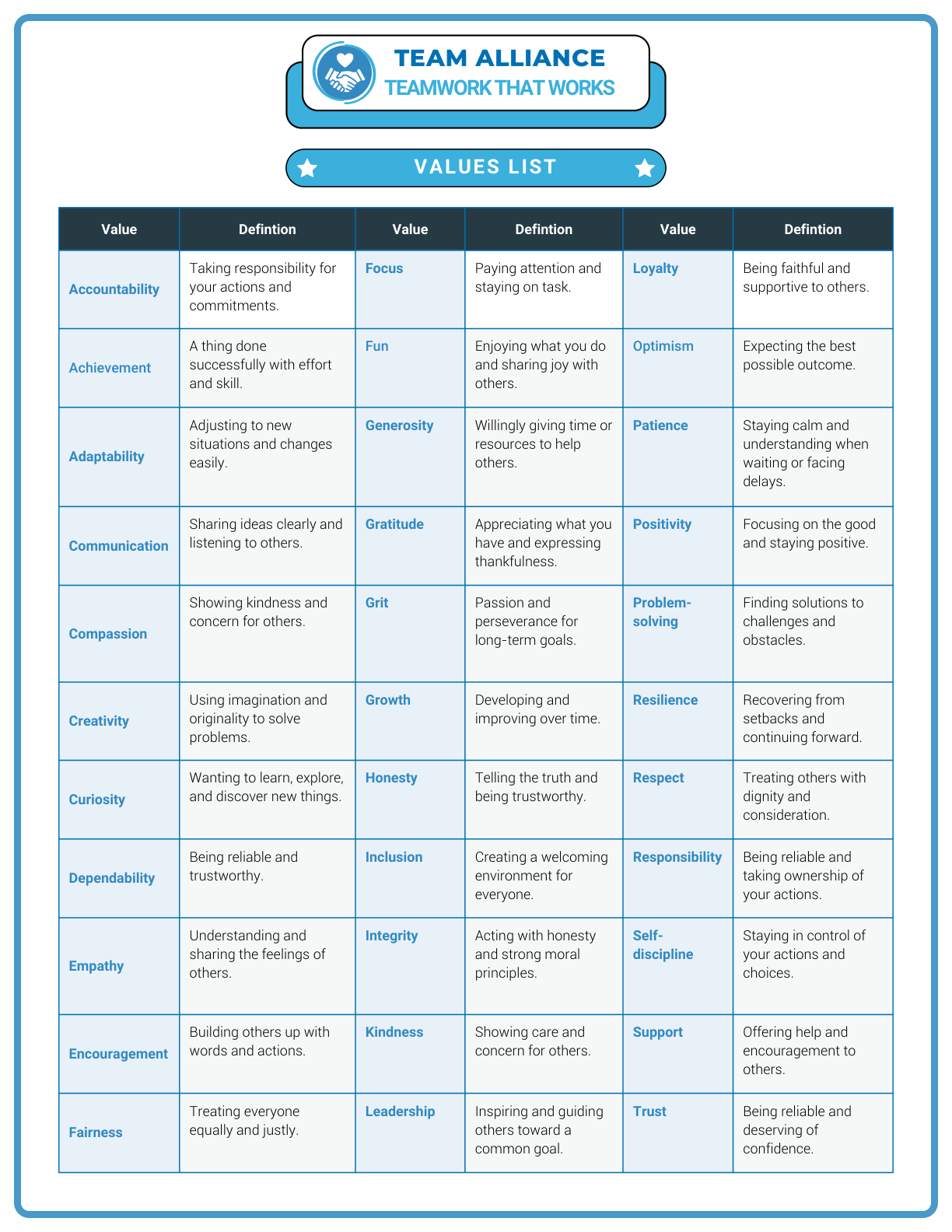
The value list matters because students are not starting from a blank page. They are choosing from better raw material.
Use the Team Alliance Template
The values list is one part of a fuller Team Alliance template. The complete template helps teams make five kinds of decisions:
- Values: what matters most for this team.
- Behaviors: what those values look like during work time.
- Conflict Protocols: what the team will do when disagreement or frustration shows up.
- Feedback and Accountability: how the team will notice and respond when commitments slip.
- Commitment: what the team agrees to practice, revisit, and improve.
The point is not to fill out a form. The point is to give students working language they can use while collaboration is happening.
What Each Part Prevents
This is not just a design preference. It matches a core cooperative learning principle: putting students near each other is not the same as creating cooperation.
Groups need shared purpose, individual and group accountability, social skills, and time to process how the group is working. Otherwise, the group can look busy while the same classroom failures keep repeating.
That maps cleanly to the Team Alliance structure.
The values section prevents the agreement from becoming a random list of rules. Students name what matters before deciding what to do.
The behavior section prevents good words from staying invisible. "Respect" becomes something the team can see, practice, and name.
The teacher becomes the conflict protocol.
A conflict protocol prevents that. Students have a next move before the disagreement turns into silence, avoidance, or a side conversation.
The feedback and accountability section prevents free riding from hiding behind the word "team." The group has already agreed how work, feedback, and missed commitments will be surfaced.
The commitment section prevents the agreement from becoming poster text. Students make the agreement something the team owns, not something the teacher assigned.
The SEL value is inside the practice. When students listen, name needs, manage frustration, repair conflict, and make responsible group decisions, they are practicing relationship skills inside real academic work.
The 21st-century skill value is inside the practice too. Collaboration and communication are not things students develop because we put them in groups. They develop when students can see, practice, and improve the moves that collaboration requires.
What Becomes Possible
When student teams can collaborate well, the teacher is no longer the only engine in the room.
That does not mean the classroom becomes teacherless. It means the teacher is not pulled into every small breakdown as the first line of repair.
Students have language for small conflicts. They have a way to talk about participation before resentment builds. They have a shared agreement they can point to when the work starts to drift.
The quiet student has clearer participation pathways.
The dominant student has clearer limits.
The student who misses a task has a better way to tell the team early instead of hiding the problem until the end.
That gives the teacher something concrete to coach. It moves collaboration from something assigned to something practiced.
Instead of saying, "Work together," the teacher can ask, "Which agreement are you using right now?" or "What does your conflict protocol say to do next?"
That is a much better conversation.
A Better Starting Question
If the first question is, "What are our norms?" students often give you broad words.
Try starting with sharper questions:
- What value matters most if this team gets stuck?
- What behavior would show that value during work time?
- What should we do when someone is not participating?
- What should we do when two people disagree?
- How will we give feedback without making it personal?
- What should happen when someone cannot do what they said they would do?
Those questions do not remove student choice. They make the choice real.
The goal is not a prettier agreement. The goal is a team that can use the agreement while the work is happening.
If your students are creating team agreements, do not stop at broad values. Give them better choices.
The Team Alliance guide gives you the canvas, facilitation flow, and option banks to help students turn values into working agreements they can actually use.