
Online Guide
Team Alliance
Forming agile student teams with teamwork that works.
The Team Alliance Canvas is a visual collaborative tool that helps teams establish shared values, behaviors, conflict protocols, feedback agreements, and accountability commitments. It gives educators and facilitators a practical way to build trust, support constructive conflict, and make teamwork visible.
Overview
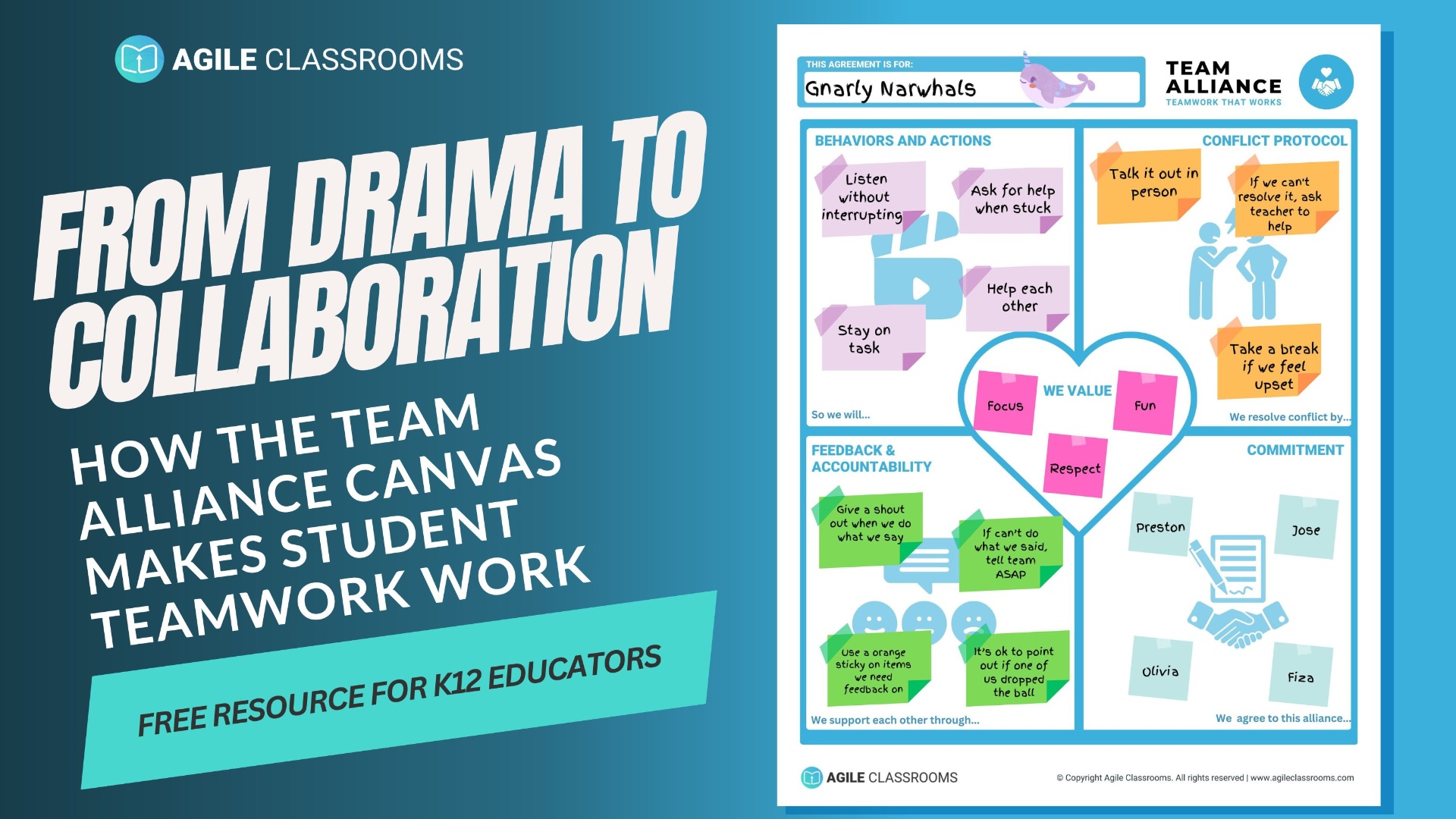
Use the Team Alliance Canvas to help any student team make their working agreements visible before the work gets hard. The activity is the foundation for trust, conflict resolution, and shared accountability.
Use this guide to
Student Learning Outcomes
The Team Alliance Canvas
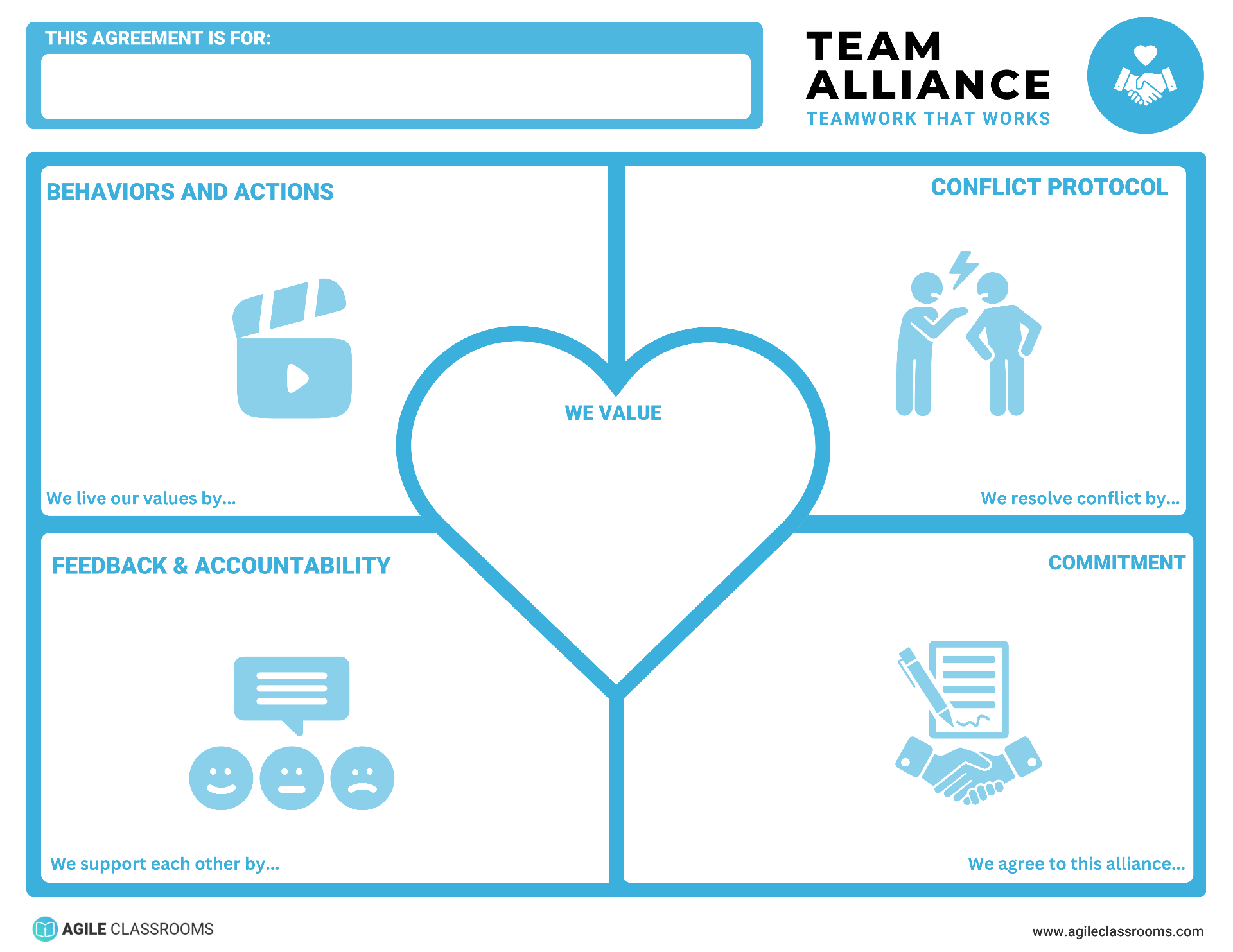
The canvas is organized into five core sections:
| Section | Description | Why it matters |
|---|---|---|
| Values | Core principles or beliefs that guide the team's culture and decision-making, such as respect, inclusion, and responsibility. | Establishes the foundation for team culture and cohesion, increasing trust and alignment. |
| Behaviors | Specific, observable actions that show how team values are put into practice. | Makes values actionable and measurable, reducing ambiguity and supporting accountability. |
| Conflict Protocol | Collaborative strategies for resolving disagreements in a way that strengthens trust and relationships. | Keeps teams from inventing conflict responses in the heat of the moment. |
| Feedback & Accountability | Processes for giving constructive feedback and staying accountable to shared goals and agreements. | Supports growth and builds trust without making students feel judged or controlled. |
| Commitment | A shared pledge to uphold the alliance. | Signing, displaying, and referring to the canvas makes the agreement visible and usable. |
The canvas helps teams
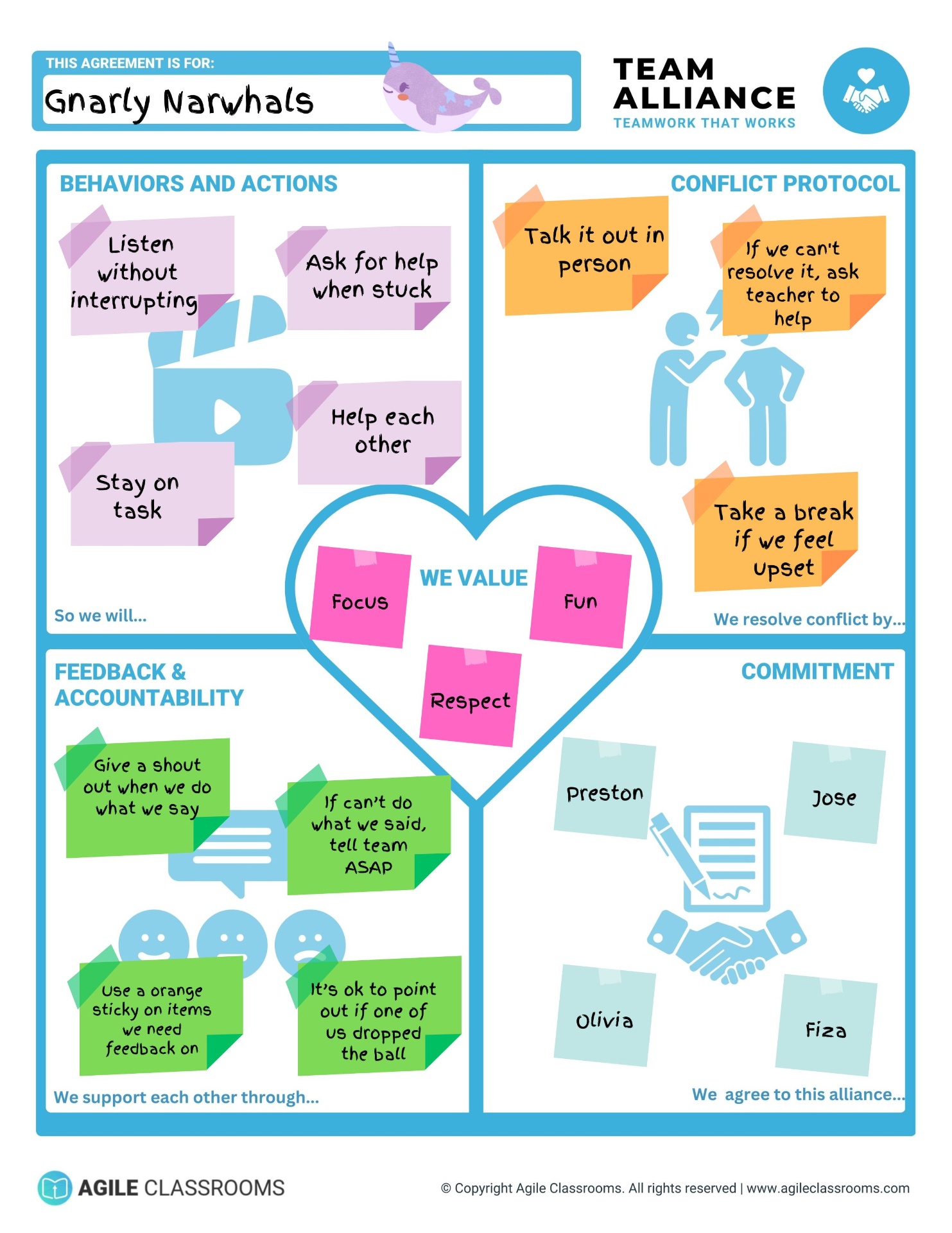
Example: The Gnarly Narwhals
Facilitation Procedure
Plan for 15–20 minutes.
Prepare
1 — Identify Values
2 — Align Behaviors
Need examples? Use the Behaviors bank below.
3 — Plan Conflict Resolution
Need options? Use the Conflict Protocols bank below.
4 — Define Feedback & Accountability
Need mechanisms? Use the Accountability Mechanisms bank below.
5 — Commit
Choose Your Team Alliance Options
Use these banks to help teams fill in the Conflict Protocols, Behaviors, and Accountability Mechanisms sections of the Team Alliance Canvas. Teams do not need to use every option. Pick a small number you can remember, practice, and revisit.
Teacher note. You can model one option from each bank before students choose. Younger students may need sentence stems or examples before they can choose independently.
Conflict Protocols
Choose 1–2How we handle disagreements
Help teams decide what they will do when they disagree, feel frustrated, or get stuck.
- Stop and Breathe — Take a moment before reacting.
- Talk to the Person First — Try to solve the problem directly before bringing in others.
- Listen First — Make sure you understand the other person's side before you respond.
- Use I Statements — Say what you feel or need without blaming.
- Ask Before Assuming — Ask a clarifying question before deciding what someone meant.
- Name the Problem, Not the Person — Focus on what happened or what needs to change, not on blaming a teammate.
- Take a Reset Break — Step away briefly, calm down, and return ready to work.
- Look for a Win-Win — Find a solution that works for the team, not just one person.
- The Help Signal — Agree on when the team should ask the teacher or facilitator for help.
- Fix It and Try Again — Repair the harm, restate the agreement, and keep going.
- Write Your Own — Add a conflict protocol that fits your team.
Younger-student support: Use simple stems such as “I need…”, “I noticed…”, “Can we try…”, or “I felt…” before asking students to write their own protocol.
Behaviors
Choose 3–5How we work together
Help teams turn values into visible actions. These should be behaviors someone could see or hear during team work.
How we talk
- Listen Without Interrupting — Let a teammate finish before responding.
- Use Kind, Direct Words — Be honest without being hurtful.
- Explain Your Thinking — Tell the team why you chose an idea, answer, or strategy.
- Disagree Respectfully — Challenge the idea without attacking the person.
- Check Understanding — Ask, “Did I understand that right?” before moving on.
How we work
- Stay on Task — Keep attention on the team goal.
- Use Team Time Well — Start quickly, avoid side conversations, and keep moving.
- Focus on the Goal — Return to the learning target or team objective when the work drifts.
- Keep Commitments — Do what you agreed to do for the team.
- Leave the Workspace Better — Clean up, reset materials, and make the next work session easier.
How we support
- Ask for Help — Let the team know when you are stuck.
- Ask Before Helping — Offer support without taking over someone else's work.
- Make Space for Everyone — Invite quieter teammates to share and make sure no one dominates.
- Celebrate Progress — Notice effort, improvement, and small wins.
- Own Mistakes — Admit when something did not work and help repair it.
- Write Your Own — Add a behavior that shows what your team values.
Teacher guidance: If students choose too many behaviors, ask them which 3–5 would make the biggest difference this week. Teams can add or change behaviors after a retrospective.
Accountability Mechanisms
Choose 1–2How we stay on track
Help teams decide how they will notice whether they are following the alliance and what they will do when they are not.
- Daily Team Check-In — Start with a quick check on the team's goal, roles, or commitments.
- Goal Check — Pause to ask, “What is done? What still needs work? What needs help?”
- Commitment Board — Keep the Team Alliance Canvas visible so the team can point back to it.
- Gentle Reminder Phrase — Choose a respectful phrase teammates can use when an agreement is slipping.
- Help Signal — Agree on a signal for when the team needs teacher or facilitator support.
- Role Rotation — Rotate roles such as facilitator, timekeeper, materials lead, or reporter.
- Partner Check — Pair up briefly to check progress, understanding, or next steps.
- Feedback Minute — Take one minute to share one thing working well and one thing to improve.
- Shout-Out Round — Name one helpful action a teammate took.
- Repair Step — When an agreement is broken, name what happened, repair it, and choose the next action.
- Write Your Own — Add a mechanism your team will actually use.
Teacher guidance: Accountability should feel like support, not punishment. Choose mechanisms that help teams notice, repair, and continue.
Standards Alignment
CASEL competencies
| Competency | Canvas alignment |
|---|---|
| Self-Awareness | Students identify and articulate shared values and personal strengths. |
| Social Awareness | Students respect diverse perspectives through discussion and shared agreements. |
| Relationship Skills | Students build collaboration and trust by defining behaviors and working together. |
| Self-Management | Students practice responsibility when following team commitments. |
| Responsible Decision-Making | Students use shared values to guide decisions and resolve conflict constructively. |
P21 & ISTE
IB Learner Profile & ATL
Evidence-Based Foundations
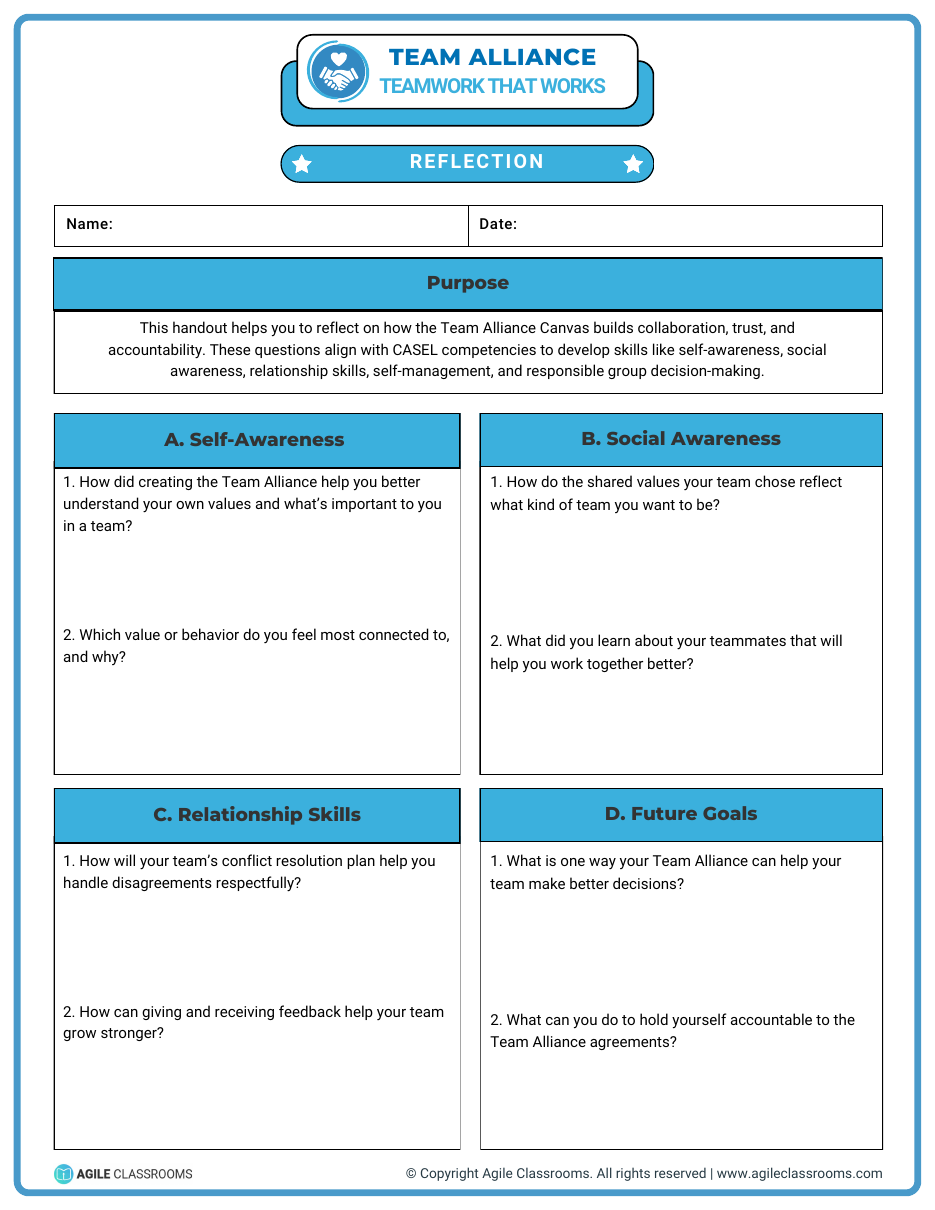
Worksheets
Download each worksheet individually, or grab the full PDF below.
Full Values List (read here or print from the PDF)
- Accountability: Taking responsibility for your actions and commitments.
- Achievement: A thing done successfully with effort and skill.
- Adaptability: Adjusting to new situations and changes easily.
- Communication: Sharing ideas clearly and listening to others.
- Compassion: Showing kindness and concern for others.
- Creativity: Using imagination and originality to solve problems.
- Curiosity: Wanting to learn, explore, and discover new things.
- Dependability: Being reliable and trustworthy.
- Empathy: Understanding and sharing the feelings of others.
- Encouragement: Building others up with words and actions.
- Fairness: Treating everyone equally and justly.
- Focus: Paying attention and staying on task.
- Fun: Enjoying what you do and sharing joy with others.
- Generosity: Willingly giving time or resources to help others.
- Gratitude: Appreciating what you have and expressing thankfulness.
- Grit: Passion and perseverance for long-term goals.
- Growth: Developing and improving over time.
- Honesty: Telling the truth and being trustworthy.
- Inclusion: Creating a welcoming environment for everyone.
- Integrity: Acting with honesty and strong moral principles.
- Kindness: Showing care and concern for others.
- Leadership: Inspiring and guiding others toward a common goal.
- Loyalty: Being faithful and supportive to others.
- Optimism: Expecting the best possible outcome.
- Patience: Staying calm and understanding when waiting or facing delays.
- Positivity: Focusing on the good and staying positive.
- Problem-solving: Finding solutions to challenges and obstacles.
- Resilience: Recovering from setbacks and continuing forward.
- Respect: Treating others with dignity and consideration.
- Responsibility: Being reliable and taking ownership of your actions.
- Self-discipline: Staying in control of your actions and choices.
- Support: Offering help and encouragement to others.
- Trust: Being reliable and deserving of confidence.
Further Learning
Keep going with workshops, certification, and the wider K-12 resource library.
Agile Classroom Framework
See how Team Alliance fits into the Agile Classroom Framework.
Open the guideCertified Agile Classrooms Teacher (ACT)
Workshop and certification for educators bringing Agile into the classroom.
Explore the workshopK-12 Resource Library
Browse free canvases, guides, routines, and team tools for student-centered classrooms.
Browse resourcesTeam Alliance PDF
Download the complete printable Team Alliance Guide with all worksheets included.
Download the PDFThis guide is a resource to inspire and support teaching practice. Educators may use it as is, modify it, or adapt parts to suit their classroom needs. The guide is licensed under the Creative Commons Attribution 4.0 International License (CC BY 4.0), allowing sharing and adaptation with proper attribution.