A Teacher's Story: When the Plan Didn't Stick
Mr. Lee had been teaching for over a decade. He loved big projects and real-world learning. But every time he tried to give students more responsibility, it backfired.
Some students raced ahead while others stalled out. The classroom was full of energy—but not direction. He found himself micromanaging, constantly reminding students what to do next. They weren't learning how to plan. They were just following instructions.
The 'why' was there. He believed in student agency and wanted students to take ownership. But the 'how' was missing.
The Planning Routine gave him the how. It turned the abstract idea of student-driven learning into something practical, visible, and doable—the routines and scaffolds that would help students actually plan their learning consistently.
That changed when he tried the Planning Routine.
It wasn't just a new way to prep. It was a shift in who owned the learning.
What Is the Planning Routine?
The Planning Routine is part of the Agile Classroom Framework, a practical approach to building self-directed, student-centered learning. It is the first of five Agile Classroom routines. It starts each Learning Sprint—a short learning cycle (usually 2–4 weeks). Students choose what they'll learn and how they'll do it.
Together with the teacher, they:
- Define a meaningful Sprint Goal (the Why)
- Select focused learning goals from the Learning Backlog (the What)
- Break them into actionable tasks on the Learning Canvas (the How)
At first, Mr. Lee was nervous. Would students take it seriously? Could they actually plan their own learning?
They could. Especially when the process was made visible.
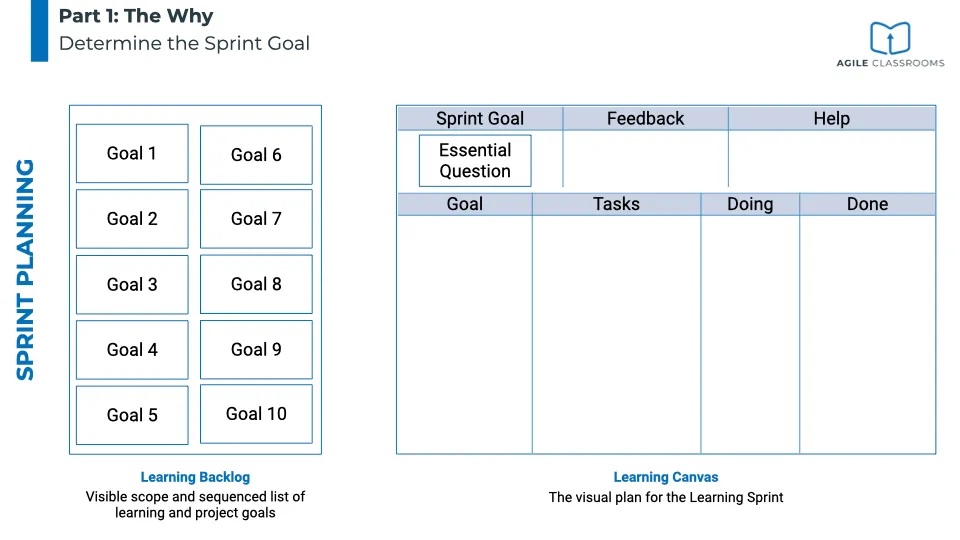
Sprint Planning - Part 1: The Why. Setting the Sprint Goal
Why It Starts With Purpose
Before jumping into tasks, the class always starts with the Why:
- What's the big idea?
- What question are we trying to answer?
- Why does this Sprint matter?
Mr. Lee asked students to co-create Sprint Goals like:
- "Investigate how ecosystems are interconnected."
- "Show how humans impact local waterways."
Suddenly, students weren't just completing assignments. They were engaged in student-centered learning with purpose and direction.
Choosing the Right Goals (The What)
From their Learning Backlog, students selected specific goals to complete within the Sprint. Not everything—just what mattered most.
Mr. Lee had them look back at previous Sprints to gauge what was realistic. That reflection made a difference. Students didn't overcommit. They chose wisely.
Each goal was moved onto the Learning Canvas. Now their priorities were visible. Now they had a plan.
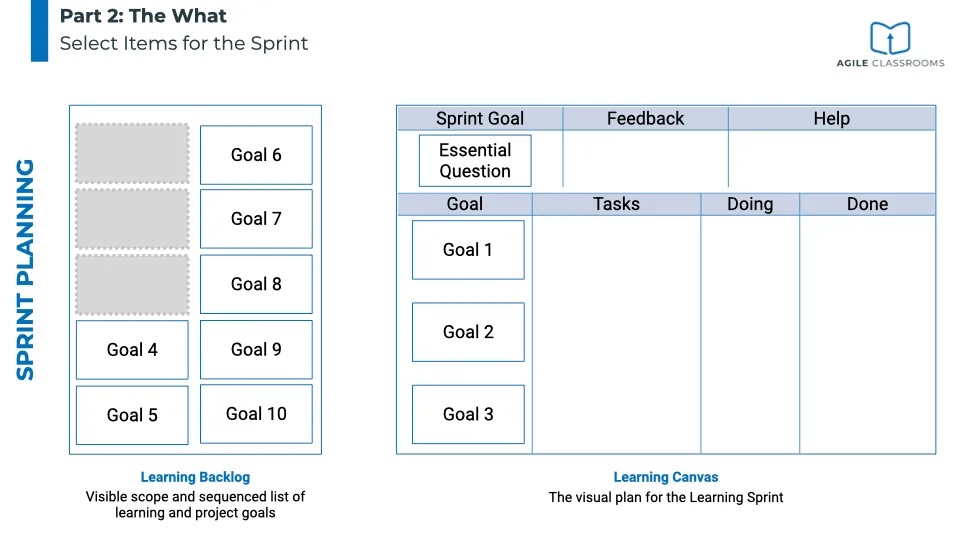
Sprint Planning - Part 2: The What. Choosing Goals from the Learning Backlog
Planning the Work (The How)
Once the goals were set, students broke them down into small tasks. Tasks that could be done in a class period. Tasks that showed progress.
Some examples:
- Research credible sources
- Create an outline
- Build a prototype
- Take a quiz
- Record a video
- Peer review a draft
Tasks varied depending on the learning model—project based learning, traditional instruction, or blended approaches. But each was tied directly to a goal.
Mr. Lee asked, "Can this task be done before our next class?" If not, it got split into something smaller. He knew that when students saw visible progress—tasks moving forward every day—it built momentum. That sense of progress motivated them to push further and achieve more.
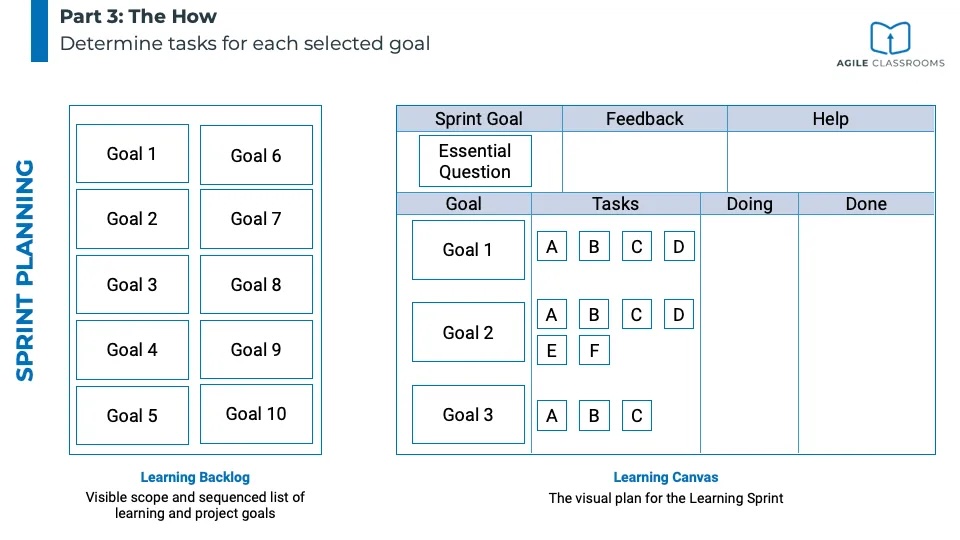
Sprint Planning - Part 3: The How. Breaking each learning goal into small achievable tasks.
Adapting the Routine Over Time
At first, Mr. Lee used a very structured approach:
- Students picked all their goals.
- Then they broke them into tasks.
Later, some students became more advanced. They began tasking as they went. Others planned one goal at a time.
He didn't need everyone to do it the same way. He just needed them to own the plan.
Letting Go of Control Is Hard—But Worth It
At first, Mr. Lee found it hard to stop directing everything. Some students struggled without step-by-step instructions. He worried that letting go of control would lead to chaos.
But the Planning Routine didn't leave teachers or students to figure it out alone.
It came with scaffolds—like the Spectrum of Choice—that allowed him to gradually release responsibility while keeping a strong structure in place. As students grew in their ability to plan, so did Mr. Lee's role evolve. He didn't vanish from the process—he rose with them.
And the Planning Routine is just one of five self-directed learning routines that make up the full Agile Classrooms Framework. As students learned to plan their own learning, Mr. Lee got to focus on what mattered most: relationships and coaching.
He had time for feedback. Time for connection. Time to actually teach.
And it didn't just improve student engagement—it saved time.
Because the Planning Routine (and the other four Agile Classrooms routines) are already aligned to standards like ISTE, CASEL, P21, IB, and others—and especially impactful in CTE, STEM, and student-driven classrooms—he no longer needed to invent separate activities to build these skills. They were built into the way students planned and learned.
Students weren't just learning what to do. They were learning how to plan.
And Mr. Lee? He stopped micromanaging. He started coaching.
He had more time for feedback, deeper conversations, and actual teaching. The classroom ran smoother. He felt less exhausted.
And for the first time in a long time, he felt proud—not just of his students, but of how they were learning.
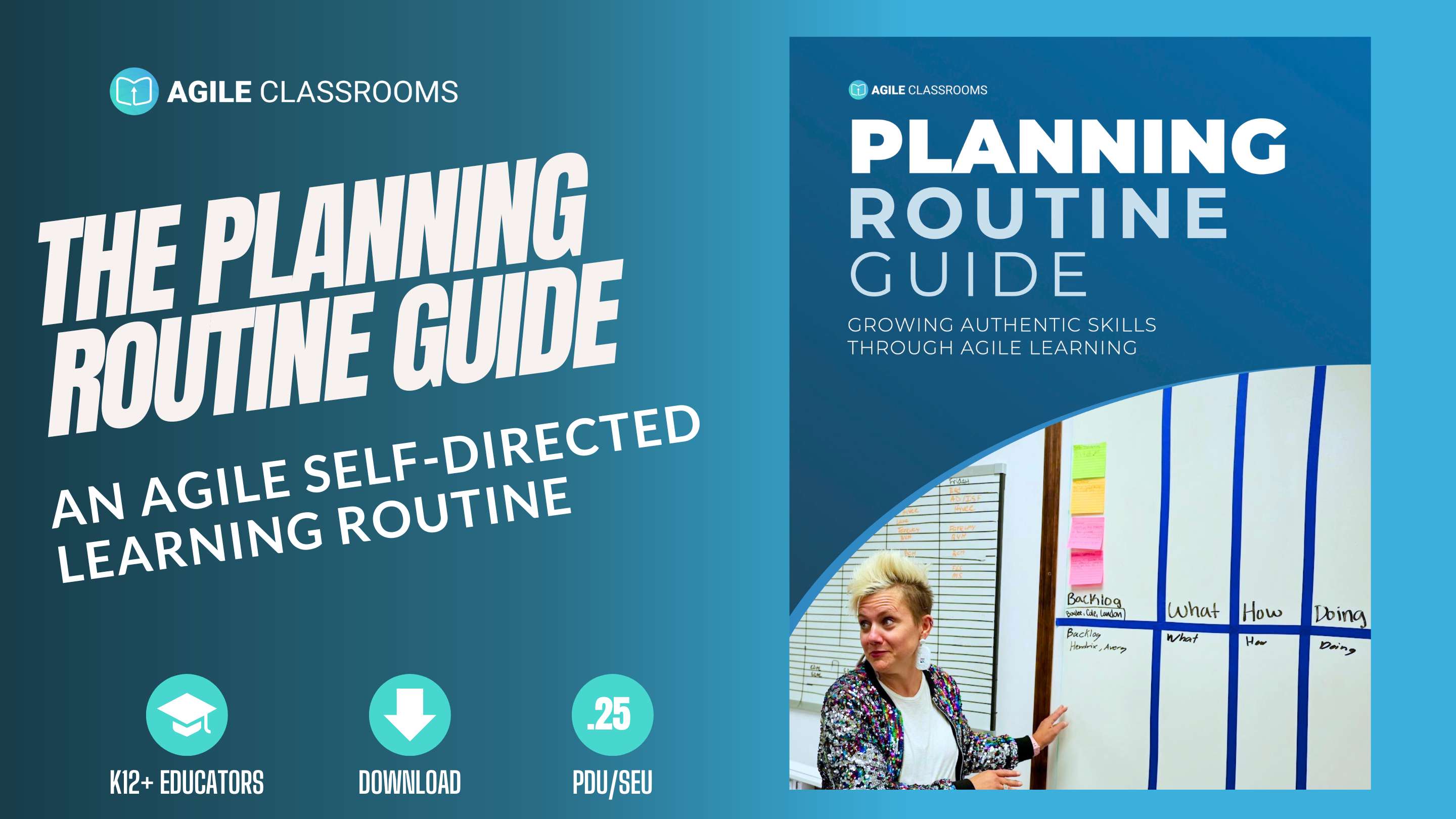
Download the Planning Routine + Feedback Guide
Want your students to plan with purpose?
Download the Planning Routine Guide + Feedback Tool to start your journey with agile teacher training and bring scrum in the classroom to life.
👉 Download the Planning Routine Guide
When students plan their own learning, they're not just engaged. They're empowered.
Be prepared to be amazed.