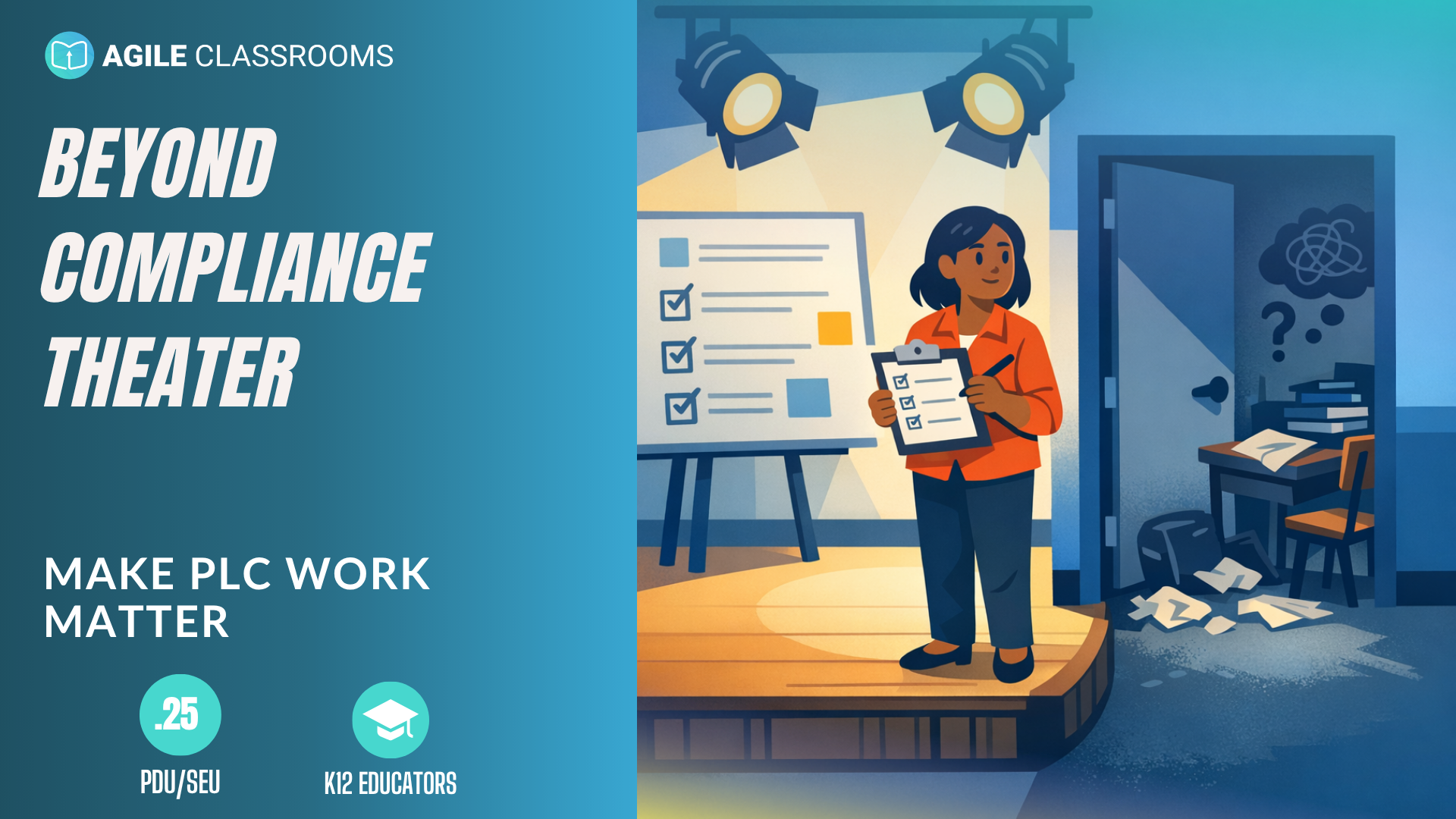
When PLCs stall, the issue is often design, not motivation. Here's why that distinction matters, and what schools can do instead.
Educators Don't Show Up to Waste Time
Teachers don't walk into PLCs hoping for more paperwork. They want to help students, improve instruction, and solve real classroom problems. Frustration runs deep when PLCs feel repetitive, heavy, or hollow. Educators aren't frustrated because they hate collaboration; they're frustrated because the collaboration isn't doing its job. That's a critical difference.
Blame Is Easy. Design Is Harder. Design Is More Useful.
When a PLC is stuck, blaming people simplifies the story. If motivation is the issue, pressure becomes the answer:
- More accountability.
- More compliance.
- Stronger monitoring.
- Tighter agendas.
- Another template.
This approach has managerial appeal. It also makes the work worse.
When people are trapped in an ineffective structure, adding pressure often produces performance, not learning. You get visible effort, polished language, and completed forms — not true improvement. That's the trap.
Schools respond to stalled progress by demanding stronger proof that improvement work is happening, even when the design of that work is the problem.
A Failing PLC Can Be Full of Committed People
This is what many systems miss. A team can be thoughtful, committed, and hardworking and still be stuck in a PLC model that doesn't help them learn effectively. They can care deeply and still spend most of their time:
- talking instead of testing,
- refining instead of trying,
- documenting instead of learning,
- protecting the plan instead of questioning its assumptions.
This doesn't mean the people are weak. It means the structure rewards the wrong moves. When a structure rewards the wrong moves long enough, even good people lose energy.
Not because they stopped caring, but because they're pouring effort into a machine that doesn't convert effort into progress.
The Motivation Story Protects the System
"Teachers don't care enough" is a persistent explanation because it protects the design. If the problem is the people, leaders don't have to question the structure. They don't have to rethink rhythms, routines, artifacts, or expectations. They don't have to confront the possibility that the PLC itself asks educators to do the wrong kind of work.
But if the issue is design, the work changes. The question becomes: What have we built teachers into? Are we helping teams learn from practice, or asking them to perform thoughtfulness in meeting form?
That's a much more uncomfortable question. It's also the one that leads somewhere useful.
The Better Question Isn't, "How Do We Get Teachers to Care More?"
A more useful question: How do we design PLC work so that caring leads to progress?
That shift changes everything.
It moves the conversation from blame toward architecture, inviting leaders to examine:
- what teams are actually being asked to do,
- whether plans are treated as hypotheses or fixed commitments,
- if routines support adaptation,
- if artifacts create clarity or paperwork drift,
- whether teams are learning from classrooms or mostly discussing them.
This diagnosis improves the work. Not because it lets people off the hook, but because it aims accountability at the thing that actually needs to change.
Better Design Creates Better Effort
When PLCs are designed well, educators don't have to be pushed into performative seriousness. They can pour their energy into work that feels real:
- small tests,
- clear next steps,
- visible learning,
- adjustments based on evidence,
- progress in classrooms, not just notes.
This kind of work restores energy because it's closer to why educators joined the profession. It's not collaboration for its own sake. It's collaboration in service of something changing.
That's what people were hoping for all along.
Adaptive PLC Starts Here
Adaptive PLC begins with a simple belief: If collaborative improvement isn't working, the first move isn't to question educator commitment. The first move is to question the design of the work.
That means building PLCs around:
- real conditions, not ideal assumptions,
- testing, not just planning,
- learning loops, not just discussion loops,
- visible progress, not compliance artifacts,
- structures that make meaningful action easier, not heavier.
This isn't soft. It's disciplined. It simply directs discipline toward improvement rather than performance.
If Your PLC Is Stuck, Start Here
Before asking how to make teachers more invested, ask whether the PLC structure gives their investment somewhere useful to go. That question is more honest. It is more respectful. And it is far more likely to produce change. Because when PLCs stall, the issue often isn't a lack of care. It's a design that keeps care from becoming progress.
Download the Adaptive PLC Guide to explore a more practical design for collaborative improvement.