Scaffold collaboration gradually
Help students grow teamwork capacity without jumping into complex group work too early.

Infographic
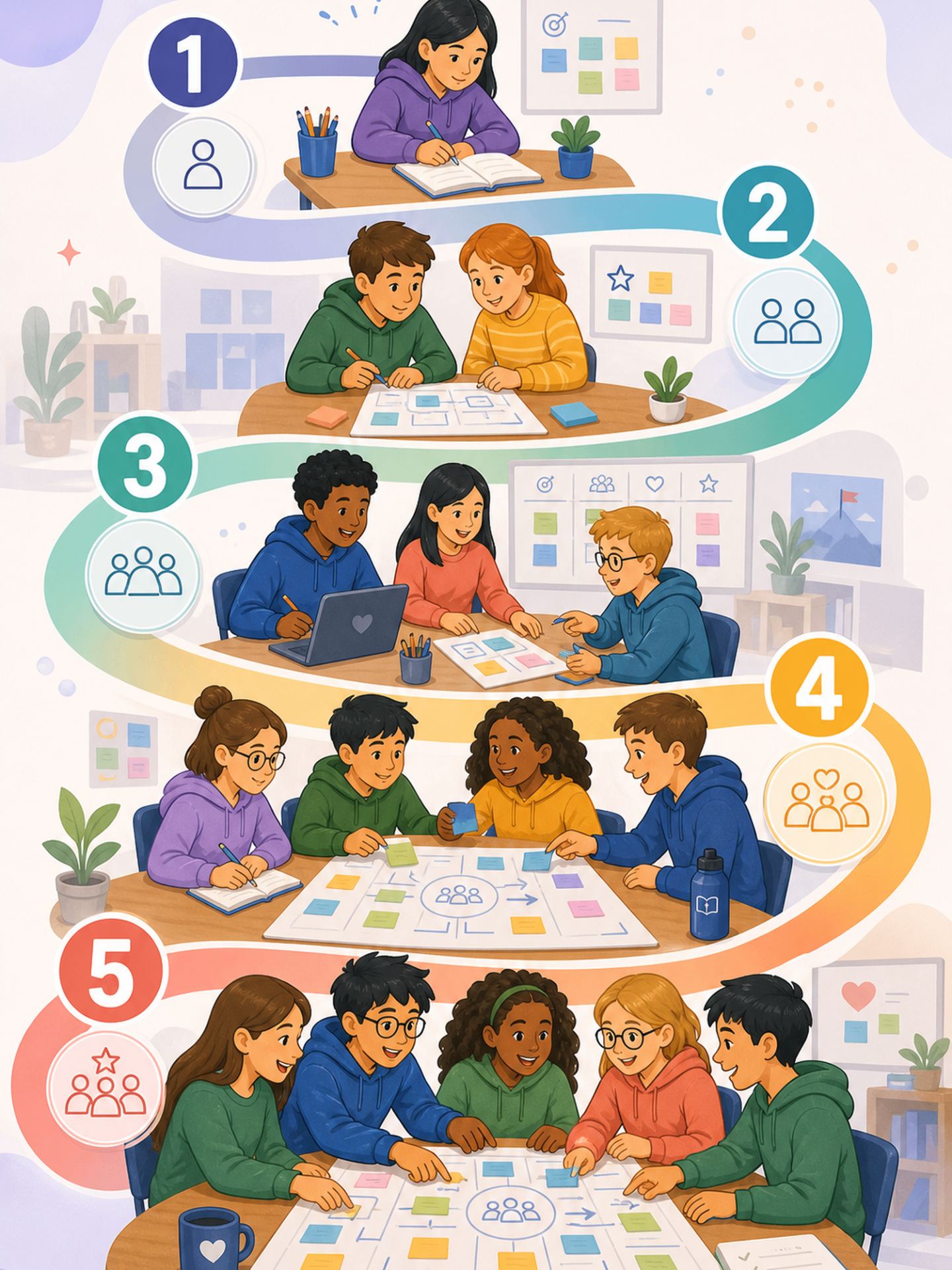
A visual guide that helps educators scaffold student collaboration from independent work toward stronger teams and whole-class collaboration.
Help students grow teamwork capacity without jumping into complex group work too early.
Choose the right level of peer interaction based on student skill, task complexity, and support needs.
Give educators and students shared language for how collaboration can develop over time.
Collaboration grows in steps — from structured pair work to student-owned teamwork.
Students work alone with structured teacher support.
Students work in pairs on shared, scaffolded tasks.
Small teams collaborate inside teacher-designed structures.
Teams plan, divide work, and check in without teacher direction.
Teams set goals, form agreements, and improve how they work.
Identify whether students are working independently, with partners, in temporary groups, stable teams, or across teams.
Move students toward more collaboration only when the task and readiness support it.
Use roles, routines, visible work, feedback, and teacher facilitation to support the next level.
Collaboration should grow over time, not be forced all at once.
Student collaboration is not all-or-nothing. Some classrooms need to begin with individual work and light peer support before moving into deeper teamwork. The Spectrum of Collaboration gives educators a way to scaffold collaboration instead of assuming students are ready for complex team structures on day one.
This helps collaboration become something students learn, practice, and improve over time.
Solo Learners — Students work independently with limited peer interaction.
Supportive Partners — Students pair up for intermittent support and feedback while staying individually accountable.
Cooperative Groups — Temporary groups work on shared goals during a Learning Sprint.
Collaborative Teams — Stable teams share responsibility, adapt roles, and work toward a common goal.
Collaborative Classrooms — Multiple teams coordinate toward a shared goal with facilitation and support.
This resource supports collaboration, communication, self-management, reflection, and team effectiveness. These are suggested connections, not a formal standards alignment.
Download the free Spectrum of Collaboration infographic and scaffold student collaboration with shared language, the right structure, and the right level of support.
Download for free