Explain the sprint rhythm
Show how the five routines fit together as one repeatable learning cycle.

Infographic
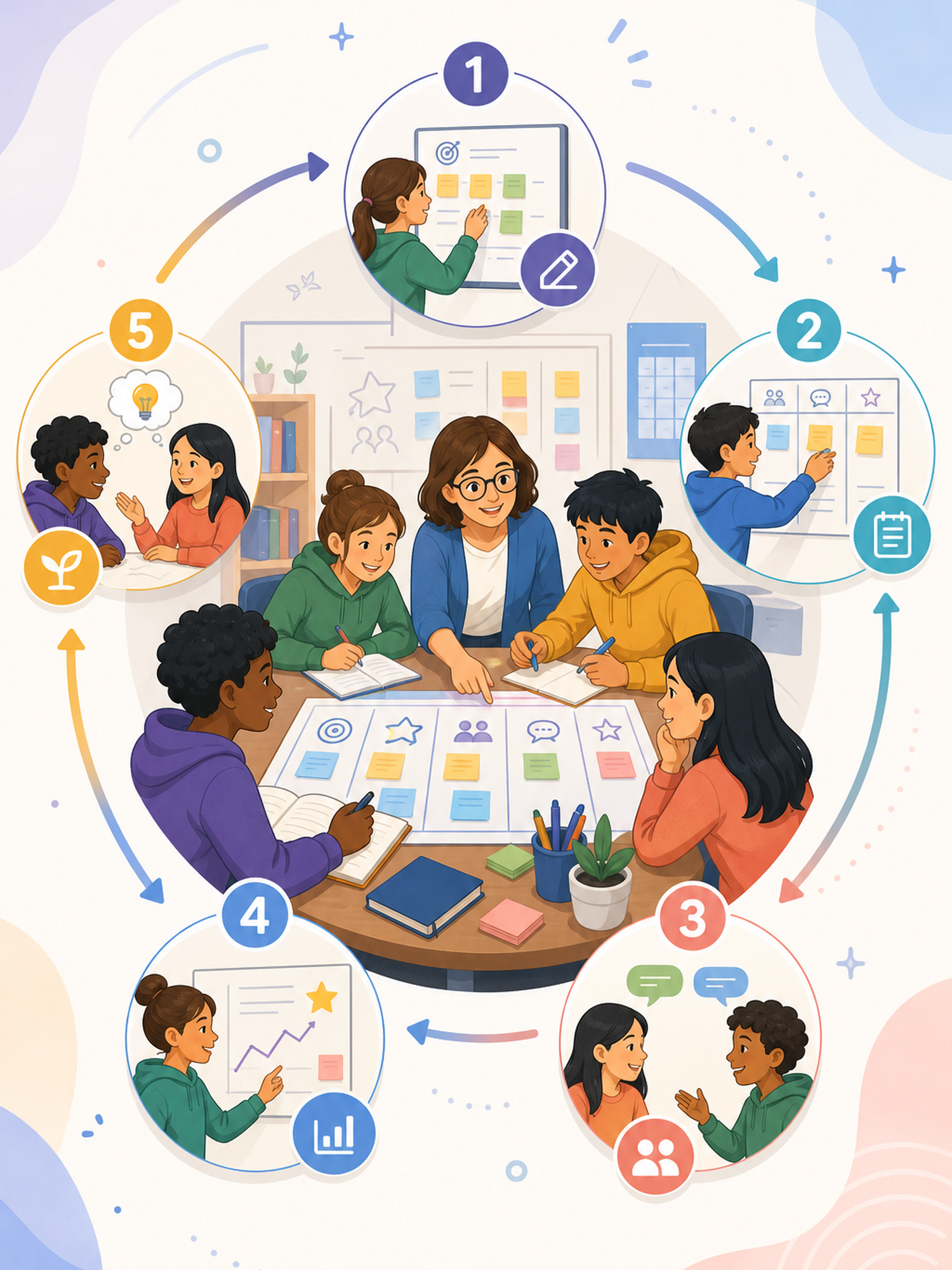
A visual overview of the five-routine Learning Sprint cycle that helps students and teachers plan, check progress, review learning, and improve how they work together.
Show how the five routines fit together as one repeatable learning cycle.
Give students a visible process for planning, adapting, reviewing, and improving.
Help the classroom use check-ins, reviews, and retrospects to make learning stronger.
Each sprint moves through the same five routines. A quick strip of what students do at each step.
Clarify what matters and break it down.
Commit to a slice of work and a goal.
Surface progress, blockers, and adjustments.
Share work and gather useful feedback.
Reflect and pick one improvement.
Clarify, prioritize, and break learning goals or deliverables into smaller pieces.
Decide what will be accomplished during the sprint and how the work will happen.
Use short conversations to align, adapt, remove roadblocks, and support progress.
Assess, validate, and gather feedback on the learning or work produced in the sprint.
Reflect on how the sprint went and choose specific commitments to improve the next cycle.
The Learning Sprint gives a classroom a repeatable rhythm. Students do not just receive assignments and turn them in. They learn to clarify the work, plan the work, inspect progress, use feedback, and improve how they learn together. The cycle is short enough for frequent adjustment and long enough to produce meaningful work.
The Learning Sprint works best when the work is visible. Pair the infographic with shared classroom artifacts that help students see the goals, organize the work, track progress, and reflect on what changed.
Helps students see the focus, goals, feedback, skills, and roadblocks for the sprint.
View resourceHelps students organize tasks, learning needs, and next steps during the sprint.
View resourceHelps students inspect the work, gather feedback, and decide what should change next.
View resourceHelps students reflect on how the team worked and improve the next sprint.
View resourceThis resource supports communication, collaboration, thinking, self-management, and reflection. These are suggested connections, not a formal standards alignment.
Download the free Learning Sprint infographic and give educators and students a simple visual overview of the five-routine cycle.
Download for free