Most assessment arrives too late.
Students do the work. The teacher scores it. Everyone finds out what happened after the learning cycle is mostly over. At that point, the assessment may be accurate, but it is not very useful for improvement. It tells students where they landed. It does not help them steer while they are still moving.
Formative assessment works differently.
It asks a better question: What can we learn from the work right now, while there is still time to adapt?
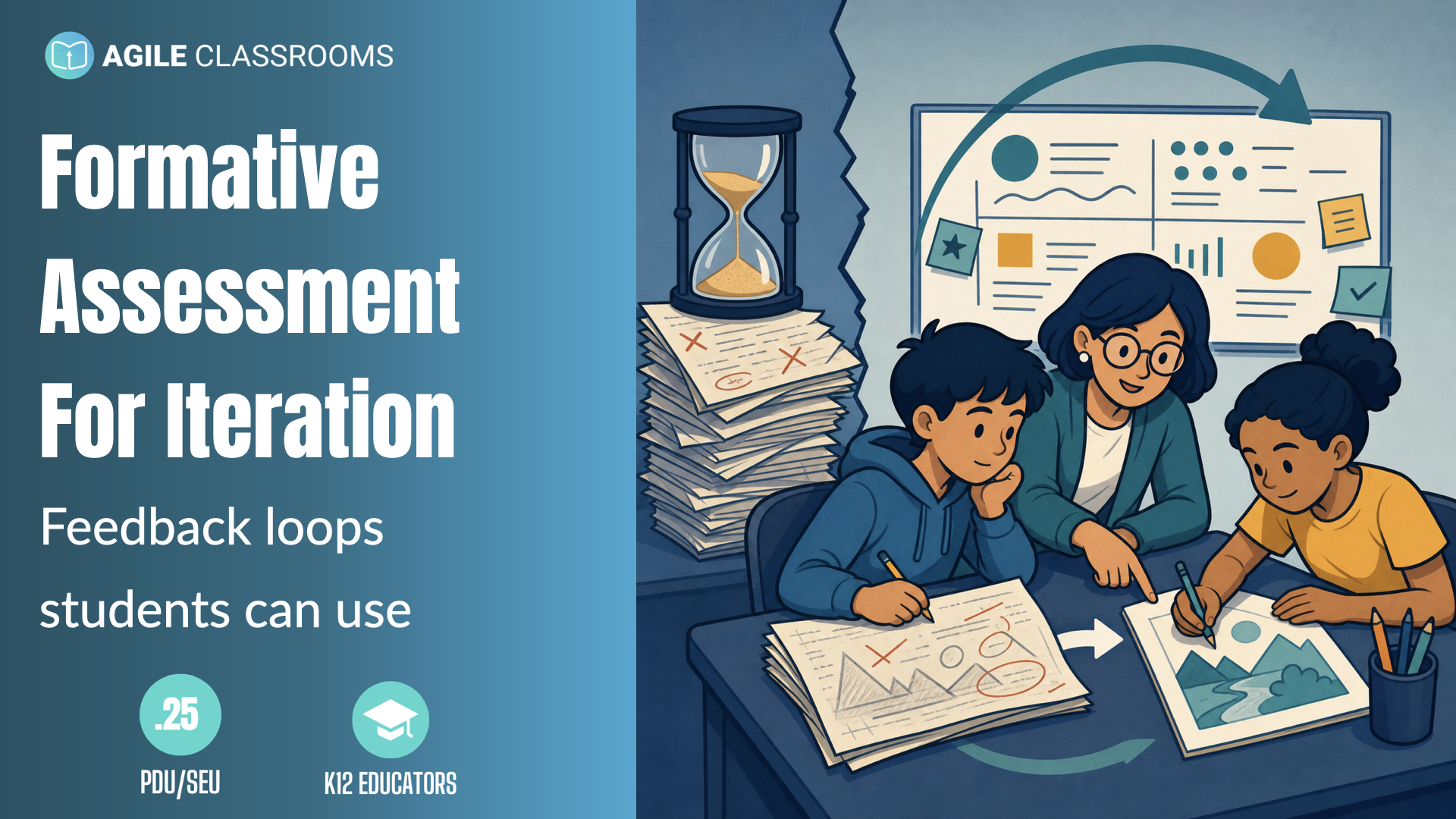
That is why formative assessment fits so naturally with Agile learning. It is not just a checking strategy. It is the feedback loop that makes iteration possible.
The Point Is Not More Assessment
Formative assessment is often misunderstood as more quizzes, more exit tickets, more data, or more teacher paperwork.
That misses the point.
A check for understanding is not automatically formative. A quiz is not automatically formative. A rubric is not automatically formative. An exit ticket is not automatically formative.
The assessment becomes formative when the evidence changes the next move.
If a teacher uses student responses to reteach, regroup, extend, slow down, change the task, or give more precise feedback, the assessment is doing formative work. If students use the evidence to revise, practice differently, ask for help, or make a better plan, the assessment is doing formative work.
The tool matters less than the loop:
- Make learning visible.
- Interpret what the evidence shows.
- Choose a better next step.
- Try again.
That loop is iteration.
Why Iteration Needs Evidence
Students cannot improve what they cannot see.
Teachers cannot adapt to learning they cannot observe.
Here is the practical power of formative assessment: it turns learning from a hidden process into something students and teachers can inspect together.
In a project, that evidence might be a prototype, a draft, a team board, a short explanation, a peer critique, a student reflection, or a quick retrieval check. In a math lesson, it might be the strategy a student used, not just the answer they reached. In a classroom team, it might be how the group communicated, divided work, or responded when the plan broke down.
Once the evidence is visible, the class has something to work with.
Not a final judgment.
A signal.
Signals make adaptation possible. They help the teacher see what needs to be adjusted. They help students see what is working, what is unclear, and what should change in the next attempt.
Without that signal, iteration becomes guesswork.
Why This Is Especially Strong For Skill Development
Skills are not built by hearing about them once.
Students do not become stronger collaborators because a teacher explains collaboration. They do not become better writers because they receive a final grade on a finished essay. They do not become more adaptive problem solvers because the class talks about growth mindset.
Skills develop through cycles:
- try the skill
- get evidence
- compare the attempt to the goal
- receive or generate feedback
- adjust the next attempt
- reflect on what changed
That is why formative assessment matters so much for student skill development. It gives practice a steering system.
A student team working through a project needs to know more than whether the final product was good. They need to know whether their communication helped or slowed them down. They need to notice whether they waited too long to test an idea. They need to see whether their feedback changed the product or just created more conversation.
Those are formative questions.
They help students learn how to learn, not just what to turn in.
This is where formative assessment connects to self-regulated learning. Students need practice setting goals, monitoring progress, choosing strategies, using feedback, and adjusting behavior. Those are not side benefits. They are core learning skills.
A classroom that uses formative assessment well does not make students dependent on teacher correction. It gradually helps students become more capable of seeing their own work clearly.
What Students Gain
Formative assessment gives students a job in the improvement process.
They learn to ask:
- What was the goal?
- What does the evidence show?
- What part is working?
- What is still unclear?
- What should I try next?
- What support do I need?
Those questions matter because they put feedback back where it belongs: inside the work.
If feedback only arrives at the end, students can file it under "grade" and move on. When feedback arrives during the process, they still have to do something with it. They can revise, recover, ask for help, try a better strategy, and see whether the change actually improves the work.
That is a different kind of ownership. Not nicer feedback. More usable feedback.
What Teachers Gain
Formative assessment also protects teachers from teaching by hope.
Without current evidence, a teacher has to infer too much. Did students understand the concept? Are they ready to move on? Which misconception is actually blocking progress? Is the group stuck because the task is unclear, the content is hard, or the collaboration routine is weak?
Formative evidence gives the teacher a sharper picture.
That does not mean every response needs to be scored. In fact, the best formative assessment often reduces grading pressure because the purpose is not to produce a permanent record. The purpose is to make a better teaching decision.
A teacher might discover:
- the whole class needs a different example
- a small group needs targeted support
- some students are ready for extension
- the task directions created the confusion
- students understand the content but need help with the collaboration process
- feedback needs to focus on strategy, not correctness
Now the plan can change for a reason.
The teacher is not abandoning the plan. The teacher is refusing to teach into the fog.
The Best Formative Assessment Is Short-Cycle
The shorter the feedback loop, the more useful it becomes.
If students only get evidence after three weeks, they may not remember the decisions that created the result. If a team only reflects at the end of a long project, the improvement advice can feel disconnected from the next opportunity to use it.
Short-cycle formative assessment keeps the evidence close to the action.
Three weeks is too long to wait to find out a team has been building the wrong thing.
That could be a two-minute retrieval check, a quick peer review, a midpoint prototype review, a team check-in, a draft conference, or a short retrospective at the end of a learning sprint.
The rhythm matters:
- What are we trying to learn or improve?
- What evidence do we have right now?
- What does it tell us?
- What will we change next?
This is why Agile learning routines are such a natural fit. They create repeatable moments for students to inspect work, receive advice, reflect on process, and adapt the next sprint.
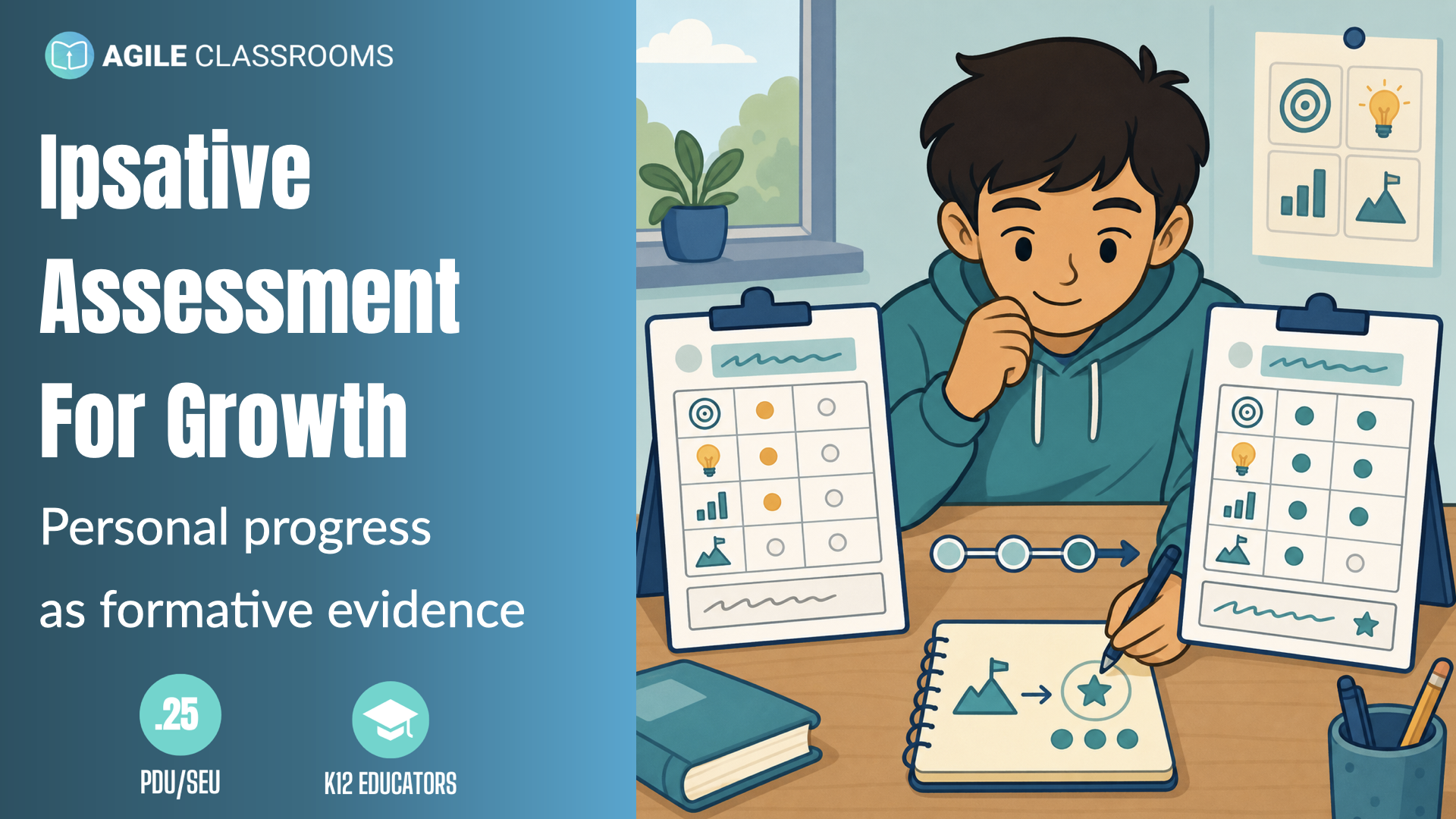
One especially useful formative pattern is ipsative assessment: comparing a student's current work with that same student's previous work. If formative assessment asks, "What evidence should change the next move?" ipsative assessment adds, "How has this learner or team grown since the last attempt?" That makes it especially useful for skill development, because students can see progress across repeated cycles instead of only seeing a score, rubric level, or final judgment.
A Classroom Example
In one science investigation, several student teams are tracking progress on a simple board: question, evidence, claim, visual, ready to share.
The teacher could wait until final presentations to assess the work. That would produce a grade, but it would miss many learning opportunities along the way.
A formative approach changes the rhythm.
Early in the sprint, students use a quick check to explain their current hypothesis. The teacher sees the same problem on three boards: the evidence column is filling up, but the comparison is blank. Students are collecting facts without knowing what those facts are supposed to prove.
That is not a small paperwork issue. It is the learning problem.
The next mini-lesson focuses on what makes evidence useful.
Midway through, teams use a review routine. They show early findings and ask classmates for advice. The feedback reveals that some teams have visuals that look polished but do not yet make the claim clear.
Near the end, students run a short retrospective. They identify what helped their team learn, what slowed them down, and one change they would make in the next sprint.
Across the cycle, assessment is not waiting at the finish line.
The teacher gets evidence for instruction. Students get evidence for revision. Teams get evidence for improving how they work together.
The final presentation will probably be better, but that is not the only benefit.
The students also practiced the skills behind better learning: noticing, comparing, explaining, revising, collaborating, and adapting.
The Routines That Make It Practical
The challenge with formative assessment is not usually belief. Most teachers already believe feedback matters.
The challenge is making the loop practical.
Classroom routines make that easier. A routine gives students a repeatable way to use evidence without waiting for the teacher to invent a new process each time.
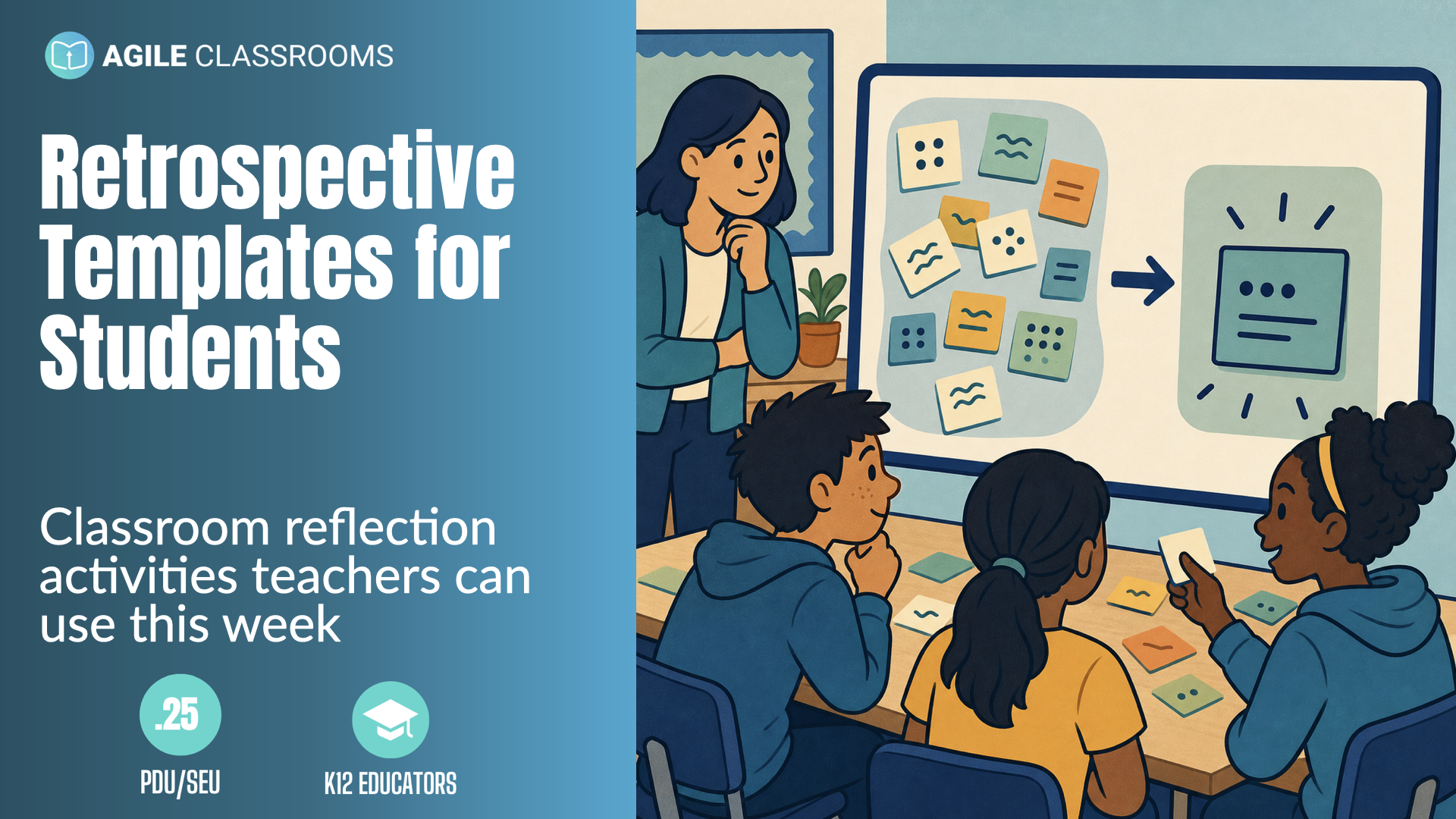
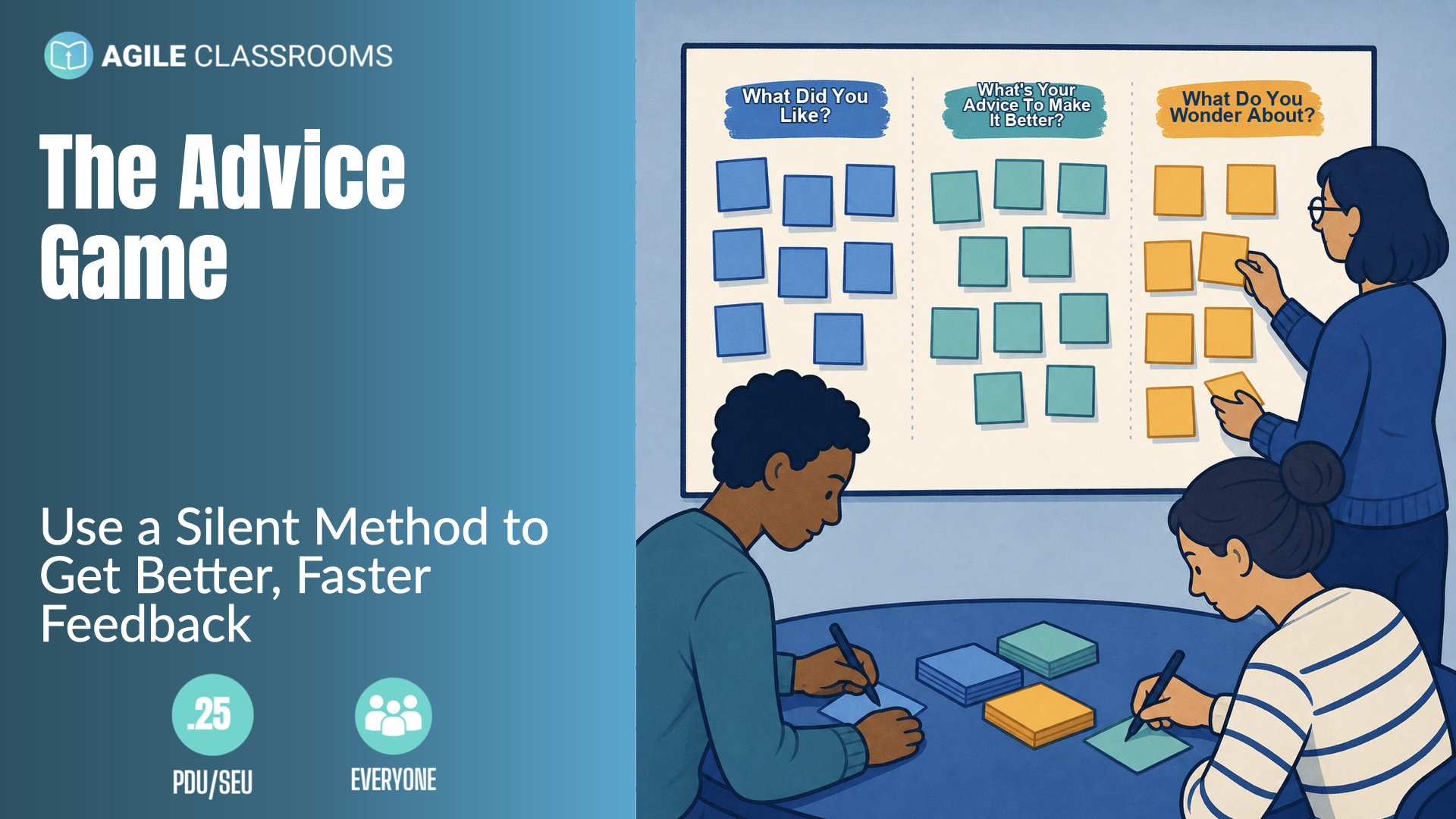
The Review routine section supports feedback on work in progress. The Advice Game helps students practice safer, more useful feedback before discussion takes over. Student Retrospective Templates give students structure for reflecting on how the work went.
Then the retrospective becomes the bridge from reflection to the next improvement.
These routines do not replace assessment. They make assessment usable.
They help students and teachers move from "How did we do?" to "What do we do next?"
Formative Assessment Is A Culture Move
The deeper benefit of formative assessment is cultural.
It teaches students that learning is not a one-shot performance. It is a cycle of attempts, evidence, feedback, and adjustment.
It teaches teachers that adaptation is not a sign that the original plan failed. Adaptation is the work.
It teaches the class that improvement is something we can organize.
That is the connection between formative assessment and Agile learning. Both depend on the same belief: the next version can be better if we make the current reality visible.
The goal is not to assess more.
The goal is to make learning easier to improve.
Take The Next Step
If you want students to practice reflection, feedback, collaboration, and adaptation as real learning skills, start with a simple retrospective routine.
Use the Retrospect routine section to help students look at how the sprint went, name what helped or got in the way, and choose one improvement for the next cycle.
That is formative assessment at its best: evidence that changes the next move.